Early years activity: Repurposing and Recycling
Teaching children about recycling will support them to develop environmentally friendly habits as they grow. This activity will challenge children to think about reusing and repurposing everyday items, encouraging them to think creatively about how objects can be given a new purpose rather than being thrown away.
Repurposing and recycling learning aims
- Share ideas about how everyday objects can be given a new purpose
- Develop communication and language
- Develop creative thinking and problem-solving skills by considering different uses for familiar objects.
Resources you will need for this activity
Gather resources accessible to your provision. Items may include:
- Empty yoghurt pots
- Cardboard boxes and packaging
- Clean food containers
- Toilet/kitchen roll tubes
- Fabric or wool scraps
- Bottle tops
- Old wrapping paper
- Vegetable and fruit peelings.
Repurposing and recycling activity outline
Prior to the activity, gather your everyday objects to show to the children.
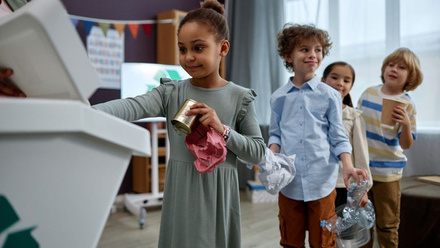
- Talk to the children about the objects you have, explain that they have been used/emptied/left over from their original purpose and would usually be put into the bin. Encourage children to discuss the types of bins they have at home. For example, household waste, recycling, garden bin etc.
- Ask the children, “Do you think we always need to throw things away when we have finished using them?” Explain that sometimes we can reuse or repurpose things by giving them a new job. Encourage the children to look at each object and think creatively about how it could be used again
- Ask questions such as:
- “What else could we use this for?”
- “Could we give this object a new job?” Encourage children to share their ideas with the group
- “What could we do with the vegetable peelings?” Discuss feeding animals or putting on a compost pile/bin
- “Could this empty yoghurt pot be useful for something else?” Children might suggest using yoghurt pots as plant pots, pencil holders, paint pots, sorting and holding small toys, or as a scoop in the sand or water tray etc.
- Discuss how reusing and repurposing helps us to reduce the amount of waste we create and is one way we can help to take care of our environment.
Ideas to extend this activity
- Create a ‘repurpose’ container for items that can be recycled and repurposed. Encourage children and families to take items and share pictures of how they have reused the items.
NDNA products to help you with this activity
Developing high quality practice - Live virtual classroom
Disclaimer: Activities with children must always be risk assessed, including for allergies or choking. Children must always have adequate supervision. Resources and materials must always be appropriate for children’s age and stage of development.