Top tips: Using mathematical language everyday with young children
The new Statutory Framework for the EYFS places an emphasis on children developing a love of maths. If maths language can be woven into their children’s everyday experiences, they will develop a secure foundation as they make progress in this area.
Top tips for using mathematical language everyday with young children
- Consider the whole of your environment and each of your daily routines as opportunities for supporting children’s rich exposure to mathematical language.
- At a staff meeting set time aside to brainstorm ideas of how to promote mathematical language throughout the nursery day for example during play opportunities and care routines. Generate a word bank with colleagues to support those who feel less confident.
- Do staff know all the types or strands of mathematical language they could use e.g. measurement, position, direction etc? Talk together about which language might be appropriate to use at different ages and stages of development.
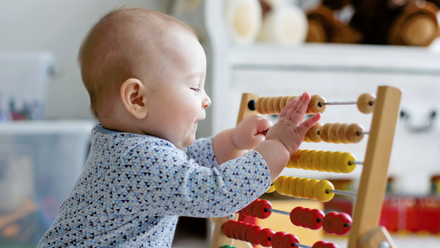
- Personal care routines are a great time have some calm focused 1:1 time with a baby or young child. They can be used as an opportunity to sing number nursery rhymes such as ‘Five Little ducks.’ Familiarity with these songs will support development across several strands of the maths curriculum.
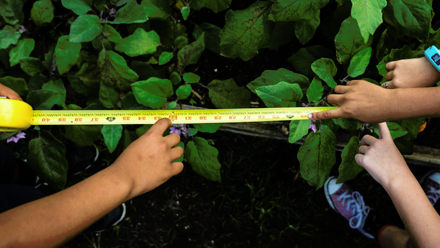
- Mealtimes, snack times or food preparation are fantastic opportunities to weave maths into everyday experiences, helping children to understand maths in context. Use mathematical language such as - full, empty, all gone, more than’. You could count, sort, match, compare of size, length or quantity, ‘Which is your longest sweet potato chip?’. Set the table together, ‘How many forks/chopsticks will we need for everyone?’ ‘Can you find 4 plates from the big pile?’ – and clearing away together.
- Talk to children about what you are doing as you prepare snack with them for example, ‘I’m cutting the pear in half’. Hold the two pieces together to show how the two halves make one whole pear.
- Have open ended problem solving conversations, ‘How can we make it fair so that everyone has the same?’
- With young children at mealtimes, comment when their plate or bowl has been refilled, “Now you have more.” This supports a baby or young child’s understanding of number and measure. Use language of position and direction for example when you are getting a baby in and out of their high chair you can use the words ‘in’, ‘out’. ‘up’, ‘down’ This helps their spatial awareness and engages them with position and direction.
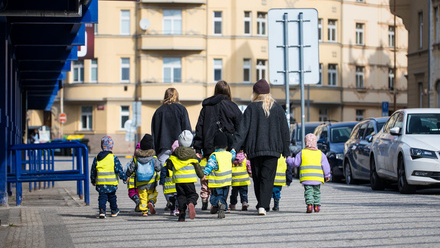
- Involve parents and carers by providing ideas of maths vocabulary to use during home routines e.g. bathtime, mealtimes or getting ready for a walk. Creating a display for parents and carers with examples of vocabulary and photos would be a lovely way to engage families.
NDNA products to help you with this tip
Online Courses in the Development Zone
Disclaimer: Activities with children must always be risk assessed, including for allergies or choking. Children must always have adequate supervision. Resources and materials must always be appropriate for children’s age and stage of development.